By Sasha Alex Lessin, Ph.D. (Anthropology, UCLA)
2013–2016: PRESIDENT NICOLÁS MADURO INHERITED CRISIS

When Nicolás Maduro assumed the presidency in April 2013 after Hugo Chávez’s death, he inherited a petro-state weakened by centralized power and deep dependence on oil rents. Chávez had built a welfare-populist state funded by high oil prices — but also entrenched patronage, weakened institutions, and polarized society across class and regional lines.
Within months, as oil prices plunged and fiscal mismanagement intensified, shortages of basic goods became chronic, inflation began rising, and political repression grew.
Maduro continued Chávez’s trend of consolidating power. The opposition-led National Assembly became a battleground, but Maduro’s allies created a parallel Constituent Assembly to sideline resistance.
Maduro leaned heavily on Venezuela’s military, intelligence services, Cuban advisers, and loyal colectivos (armed community groups) to maintain control, not merely political survival but a hardened domination regime. In a common ploy of Anunnaki domination politics, Maduro fused state power with criminal networks and the security apparatus, shaping a country where ordinary Venezuelans served as pawns in competing interests. The ruler and the elite prioritize hierarchy and suppress broad participatory governance.
“Every day there’s another line for milk,” a shopkeeper in Caracas told a visiting reporter, exasperation overtaking despair.
“We are trapped by price controls, corruption, and scarcity,” a university student in Maracaibo said, reflecting the rising frustration across generations.
2016: HYPERINFLATION & MASS MIGRATION

By 2016, Venezuela had entered hyperinflation, with currency losing value at rates among the highest ever recorded. Ordinary savings evaporated, wages became near-worthless, and unemployment soared.
Faced with famine-like conditions, more than seven million Venezuelans fled — primarily to neighboring Colombia and Brazil, but also to the United States and Europe — creating one of the largest mass migrations in the Western Hemisphere in modern times.
“I left for my children’s future,” said María, who now lives in Colombia. “We walked for days. Here, there’s hope — but my heart is still in Venezuela.”
This exodus distorted families and economies across the region, with diaspora communities contributing remittances back home even as they struggled to build new lives abroad.
2017–2019: POWER STRUGGLE & INTERNATIONAL FRICTION
As economic conditions worsened, Venezuela’s opposition — led by the National Assembly — claimed popular support. In 2019, Juan Guaidó declared himself interim president, citing constitutional provisions after Maduro’s contested re-election.

Over 50 countries, including the U.S., Canada, and many in Europe and Latin America, recognized Guaidó.
Maduro, however, refused to relinquish power. He relied on military loyalty, security forces, and support from Cuba, Russia, and Iran to retain control.
The United States imposed crippling sanctions on oil and financial flows, aiming to choke off the revenue that propped up Maduro’s government. Sanctions also targeted individuals, including Maduro himself, who was indicted in U.S. federal court on narco-trafficking and narco-terrorism charges — allegations the Maduro camp denied while accusing Washington of imperial intrusion.
The Catholic Church & Religious Dimensions
Throughout the crisis, the Roman Catholic Church emerged as one of the few independent voices. Venezuelan Catholic bishops frequently criticized Maduro’s government, denouncing abuses and calling for justice, political prisoners’ release, and respect for democratic norms. The Vatican, under Pope Francis, attempted to mediate but maintained neutrality, urging dialogue and peaceful solutions.

Maduro’s relationship with the Catholic hierarchy was often tense; some regime figures accused the Church of siding with the opposition, leading to rhetoric denouncing clergy and even derogatory language toward bishops.
Nevertheless, Church leaders remained vocal advocates for the suffering population and frequently called for reconciliation during the protracted crisis.
“Only moral institutions can speak truth to power, said one Priest, “and we must be that voice without fear.
By 2024, Venezuela’s economy had contracted sharply, and state institutions had collapsed. People could only survive in their informal networks. Corruption, crime, and scarcity confronted them daily.
2024–January 2026 FRAUGHT ELECTIONS & ESCALATING SANCTIONS

In the run-up to the 2024 presidential election, Venezuela’s opposition rallied behind MARÍA CORINA MACHADO, a long-time critic of Maduro. Voters poured out to the opposition primaries and chose Machado by a landslide to lead the challenge. Maduro’s institutions struck back fast. The Comptroller General declared Machado ineligible for public office and the regime-controlled Supreme Court upheld the ban.
Machado refused to quit. She named respected academic Corina Yoris as her substitute candidate. Election authorities blocked Yoris from registering, shutting the door again. The opposition coalition regrouped and placed former diplomat Edmundo González Urrutia on the ballot as their unity candidate.
Election day arrived amid fear and hope. Observers reported intimidation, restricted access for monitors, and irregular vote counting. The government announced another Maduro victory. The opposition produced its own tallies and claimed González won decisively. Protests erupted across the country. Security forces answered with arrests and crackdowns.
International sanctions tightened. Washington and European capitals questioned the official results. Maduro dug in, declared foreign plots, and tightened his grip on power.
Maduro declared victory, prompting further diplomatic isolation and expanded sanctions from the United States and its allies. International observers described the polls as neither free nor fair, and public trust in electoral institutions collapsed.
The Nobel Peace Prize Committee awarded the Prize to María Corina Machado, who said she would give it to Trump. The Committee said she could give him her plaque but could not change the award, which remained in her name.
Early 2026: U.S. INTERVENTION & MADURO’S REMOVAL

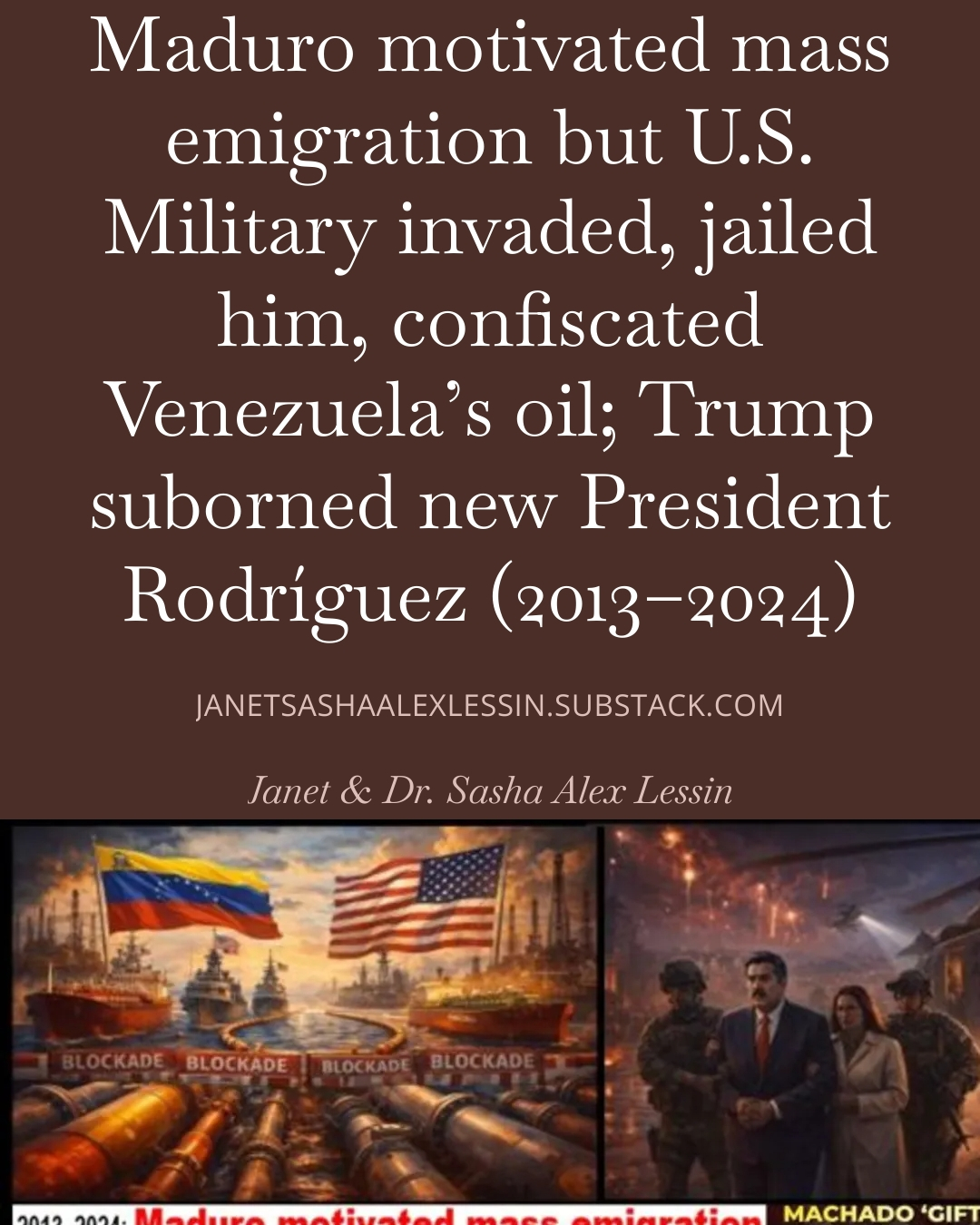
In January 2026, U.S. forces entered Venezuela, struck Caracas, and captured President Nicolás Maduro and his wife, Cilia Flores.
Trump announced Maduro’s ouster and transfer to New York to face charges of narco-trafficking and weapons violations.
This marked the first direct U.S. military intervention in Venezuela since the 20th century. Trump touted the attack as part of his Trumproe Doctrine, of U.S. control of the entire Western Hemisphere, and revealed that he had designs on all of Venezuela’s oil for American purposes.
AFTERMATH: POWER REALIGNMENT & OIL STRATEGY

In the weeks following Maduro’s capture, U.S. naval operations seized sanctioned tankers and imposed blockades, sharply reducing Venezuela’s oil exports — particularly to China and Cuba — while diverting legal shipments to U.S. refineries. Interim leader Delcy Rodríguez, backed by Washington, surrendered the country’s oil to the U.S. and, backed by Trump, consolidated her authority over Venezuela, subject to American oversight.
Among Venezuelans abroad, reactions are mixed: many celebrated Maduro’s fall as overdue justice, while others fear renewed instability, discrimination, or possible forced repatriation.
TRUMP RULES VENEZUELA’S OIL EXTRACTION & SALES
Under Operation Absolute Resolve, the U.S. and interim Venezuelan authorities have begun a new oil covenant — directing production, lifting some sanctions on energy flows, and courting multinational investment under conditions favorable to Washington’s energy strategy.
DOMINION AND LIBERATION
Venezuela’s arc from Chávez to Maduro to Operation Absolute Resolve reflects the ongoing struggle between centralized domination and the aspirations of ordinary citizens that the domination mindset clandestinely imposes on us Earthlings, as Anunnaki and their Earthling agents like both Madero and Trump do.
#Maduro #VenezuelaCrisis #Sanctions #MassExodus #OilPolitics #OperationAbsoluteResolve #CatholicChurchVenezuela #AnunnakiMindset #USIntervention #HumanitarianCrisis #SashaAlexLessin
I would, dear Readers, much appreciate you sharing this post with your audiences.