Irish Migration, Shays’ Rebellion, Cromwell’s Dictatorship, Parsons’ Pattern, and Monopoly Capitalism**
By Sasha Alex Lessin, Ph.D., Anthropology (UCLA)
Introduction: THE STORY OF CLASS IS THE STORY OF DOMINATION
From Cromwell’s conquest to the Irish diaspora, from Shays’ Rebellion to modern monopoly capitalism, one thread ties the ages together: Class. Class is not merely an economic location—it is a pernicious caste system, reproduced through culture, violence, and inherited privilege.
Talcott Parsons thought societies evolve from ascribed status (birth, bloodline, religion) to achieved status (talent, skill, performance). But in real history — Irish or American—ascription reappears in disguised form. Inherited capital, monopoly ownership, political capture, and cultural gatekeeping recreate the same old aristocracy under new names.
Marx explained the struggle. Bourdieu identified the subtle markers that enforce it. Piketty showed how wealth concentration accelerates it.
Parsons hoped achievement would replace birthright—but the modern world proves the opposite: birthright returns whenever capital accumulates. This is the pattern of domination, from Anunnaki epics to British plantations to Wall Street today.
This post integrates our mentors’ contributions to the study of class as follows: Irish migration→ Cromwell→ Shays→ Parsons→ Marx→ Bourdieu→ Monopoly Capitalism→ Chomsky’s contribution.
CROMWELL’S CONQUESTS CLARIFIED THE U.K.’S CLASS CONFIGURATION
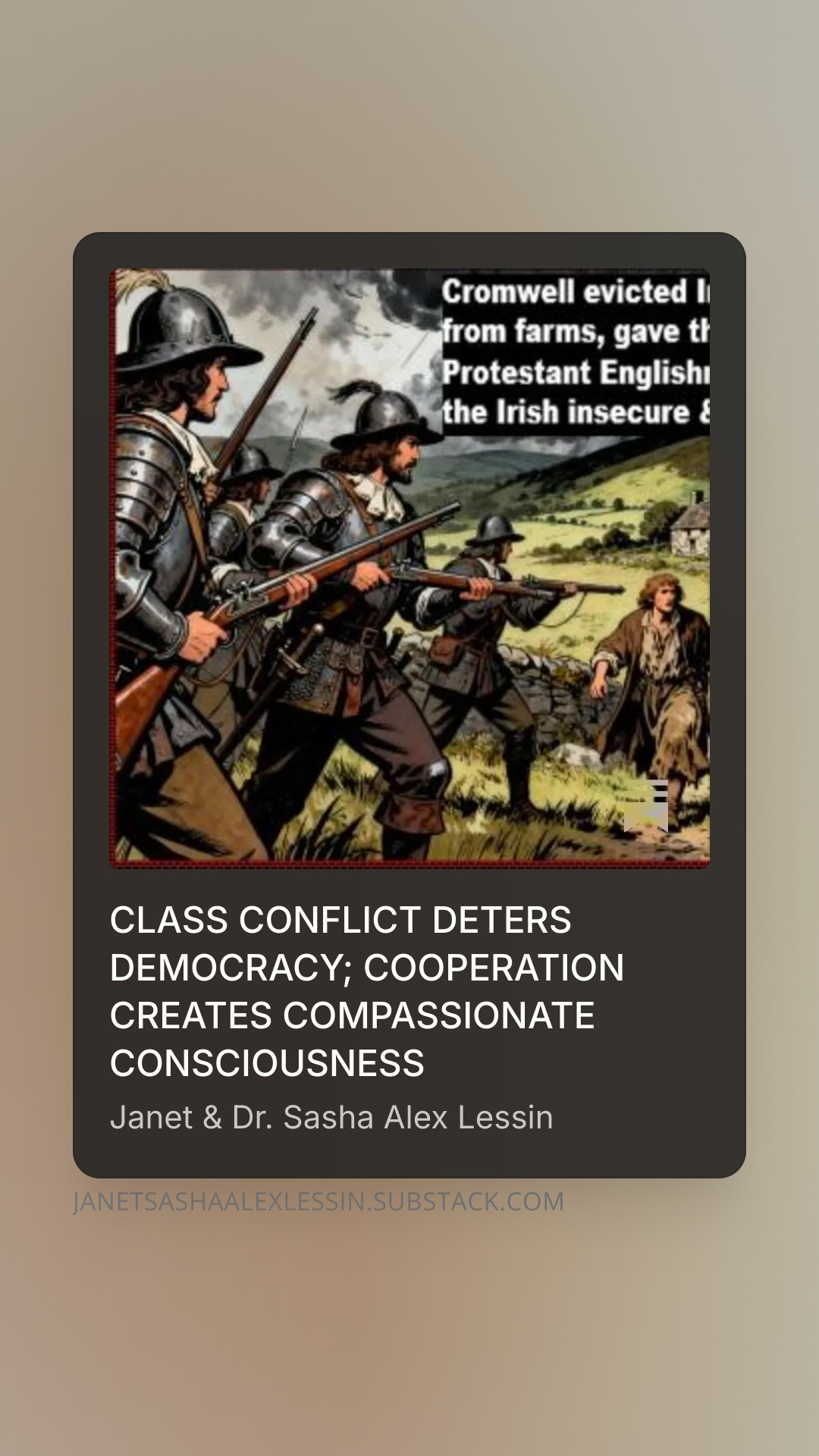
In the 1640s–1650s, Oliver Cromwell ruled the British Isles with Puritan zeal and iron discipline. He crushed Irish resistance, seized Catholic lands, and redistributed millions of acres to Protestant English soldiers, merchants, and creditors. His regime resulted in an aristocracy of ascribed dominant Protestant landowners, dominated Irish farmers who suffered insecurity, debt, servitude, and evictions, and a plantation economy into which the British military force imposed servitude on the Irish Catholics. The Irish class wound up metastasizing later into Irish migration, famine, and rebellion.

IRISH MIGRATION: CLASS AND EMPIRE CRUSHED A PEOPLE
By the 18th and 19th centuries, Irish Catholics were locked into a caste: landless, disenfranchised, starved by policies designed to enrich British landlords.
When the GREAT HUNGER (1845–1852) struck, it was not simply famine — it was famine within a class system.

The Irish fled to America not as free migrants but as refugees from a forced class position created centuries earlier.
The largest waves of Irish emigration to America (especially the mid-19th century) departed from Queenstown (Cobh)—formerly called Queenstown — in southern Ireland. Many famine-era emigrants left from it aboard “coffin ships” and later steamships heading for North America.

Before Cobh became dominant, Irish emigrants also left from ports such as Dublin, Belfast, and Derry. Later, many Irish emigrants first crossed to England (especially to Liverpool) and then boarded ships to the United States.
Upon arrival in America, they met:
-
Bosses who hired them as cheap labor,
-
Nativists who despised them as “lesser stock,” and
-
Police and political machines who exploited their desperation.
Yet they fought their way upward — often used as strikebreakers or soldiers in the Civil War draft, caught between domination from above and survival from below.

SHAYS’ REBELLION: WHEN AMERICAN FARMERS SAID “ENOUGH”
After the Revolution, poor veterans — unpaid by the new government — returned home to debt, foreclosure, and courts run by wealthy creditors.
Farmers like Daniel Shays rose, demanding relief.

The rebellion was crushed, but the message was clear:
Capital already ruled the new republic, and class already decided destiny.
This uprising foreshadows today’s struggles: When debt and monopoly crush the many, rebellion simmers.
PARSONS’ VISION: FROM ASCRIBED TO ACHIEVED — OR SO WE HOPED
Talcott Parsons argued that social evolution moves from ascribed status (birth, family, religion) to achieved status (education, skill, performance).
But the societies he praised (Britain, America) showed the opposite trajectory: Ascribed privilege becomes invisible but stronger once it hides behind “achievement.” When wealth is inherited, when schools filter by social background, and when cultural traits signal belonging, achievement masks domination. This is why Parsons’ original formulation must be reframed: The shift from ascription to achievement is never complete where capital accumulates.
MARX → PIKETTY → BOURDIEU: THE STRUCTURE OF CLASS AND THE CULTURE THAT ENFORCES IT
Marx wrote that class depends on your relationship to the means of production. Workers sell labor, but capitalists own the world.
Piketty added that over centuries, capital concentrates through profit + inheritance — creating a new aristocracy.
Bourdieu wrote: Class reproduces itself through economic capital (MONEY), Social capital (CONNECTIONS), and Cultural capital (TASTE, ACCENT, MANNERS, CLOTHES, MUSIC). The ruling class stays on top not just through wealth but through cultural codes that tell everyone where they “belong.” Together, they reveal the iron mechanism beneath “modern civilization.”
MONOPOLY CAPITALISM: THE ENGINE OF THE NEW CASTE SYSTEM
Modern capitalism produces monopolies — megacorporations, financial empires, tech giants, agribusiness, media conglomerates.
When a few own everything:
-
Democracy collapses
-
The middle classes evaporate
-
Social mobility stalls
-
Culture becomes a tool of obedience
-
Achievement stops mattering
-
Ascribed class returns — by inheritance of capital

Monopoly capitalism is caste with credit cards, feudalism with spreadsheets.
CHOMSKY’S “REQUIEM FOR THE AMERICAN DREAM” — A SUMMARY
Noam Chomsky’s Requiem for the American Dream shows how the top fraction of 1% systematically reshaped American laws, taxes, labor policy, education, and media to consolidate wealth and dismantle democracy. He identifies 10 principles of wealth and power concentration, revealing how the elite engineer apathy, crush unions, privatize public goods, and convert citizenship into consumerism.
His core message mirrors Marx, Piketty, and Bourdieu: when wealth concentrates, democracy dies — and class becomes destiny.
ANUNNAKI FRAME: DOMINATION VS PARTNERSHIP
The Hybrids, who are the hidden Anunnaki controllers, Enlil/Yahweh and Marduk posing as Yahweh, imprint hierarchy, conquest, competition, centralized power, obedience on our societies; whereas the partnership-cooperative consciousness that Ninmah, the Anunnaki Great Goddess, offers, primarily through women and enlightened groups who free themselves from domination institutions and religions, teach sharing, caring and love.
From Cromwell to Wall Street, the Enlilite pattern dominates: Class stratification → monopoly power → cultural control → inherited caste → domination.
Yet the partnership impulse never dies. Irish communities, Shays’ farmers, and modern workers all echo the ancient struggle to reclaim egalitarian balance.
TOWARD A FUTURE OF PARTNERSHIP
History shows that class systems collapse only when people remember they deserve better.
Irish migrants remembered.
Shays’ farmers remembered.
Chomsky reminds us now.
The question is whether humanity — battered by monopoly capitalism — will choose partnership over domination.
REFERENCES
-
Noam Chomsky, Requiem for the American Dream, film documentary, 2016, Gravitas Ventures.
-
Thomas Piketty, Capital in the 21st Century, 2014, Harvard University Press.
-
Pierre Bourdieu, Distinction: A Social Critique of the Judgment of Taste, 1984, Harvard University Press.
-
Karl Marx, Capital, Vol. 1 (1867), Penguin Classics.
-
History of the Irish Famine, BBC and RTÉ documentary sources.
-
Shays’ Rebellion, Massachusetts Historical Society.
-
Cromwell and Ireland, National Archives UK.
STRUCTURAL CLASS POSITIONS
| Class Position | Historical Examples | Economic Base | Dominant Behaviors | Spiritual Alignment |
|---|---|---|---|---|
| Hereditary Elite | Cromwellian landlords, British aristocracy, modern billionaire dynasties | Land, monopoly capital, inheritance | Command, regulate, privatize, enclose | Enlilite Domination Current |
| Managerial–Professional Strata | Magistrates, overseers, clergy, modern corporate execs, technocrats | Salaries, credentials, cultural capital | Gatekeeping, enforcing rules, maintaining hierarchy | Mixed; often Enlilite organizational patterns |
| Petty Bourgeois / Middle Class | Shopkeepers, small farmers, colonial tradesmen, small business owners | Small property, limited capital | Compete, aspire upward, fear downward mobility | Mixed; oscillates between currents |
| Working Class / Proletariat | Irish laborers, factory workers, tenants, immigrants | Wages, unstable jobs | Cooperate for survival, solidarity, and suppressed by debt | Enkite Partnership Current |
| Underclass / Marginalized | Famine-struck Irish, indentured servants, slaves, sharecroppers, modern gig workers | No stable base; debt and dispossession | Resist, evade, rebel (Shays, Molly Maguires, etc.) | Strong Enki-ite Current |
CULTURAL CAPITAL & CLASS SIGNALS (Bourdieu)
| Class | Cultural Markers | Social Capital |
|---|---|---|
| Elite | Opera, private schools, “proper accent,” exclusive clubs | Extensive networks, inherited connections |
| Middle Class | Degrees, polite speech, professional dress | Moderate networks, aspirational contacts |
| Working Class | Folk music, pubs, plain dress, regional accents | Local networks, family bonds |
| Migrant/Underclass | Cultural suppression, survival behaviors, “improper” accents | Weak networks; exclusion |
ACHIEVED vs ASCRIBED STATUS (Parsons)
| Domain | How It Looked in Theory | How It Works in Reality |
|---|---|---|
| Achievement | Skill, talent, hard work determine success | Elite-owned schools and credentials determine access |
| Ascription | Birth, family, religion decide rank | Returns through inheritance, capital accumulation, ethnic favoritism |
| Modern Outcome | Meritocracy | Monopoly capitalism = neo-feudal ascription |
ECONOMIC STRUCTURES (Marx → Piketty)
| Group | Relation to Means of Production | Historical Expression |
|---|---|---|
| Bourgeoisie | Own land, factories, money, patents | Cromwell’s landlords, industrialists, today’s tech/finance giants |
| Proletariat | Sell labor for wages | Irish immigrants, colonial farmers, modern workers |
| Capital Concentration | Profit → inheritance → elite power | Piketty’s finding: capital returns > wage growth |
BEHAVIORAL PATTERNS (Anunnaki Lens)
| Pattern | Traits | Historical Examples |
|---|---|---|
| Enlilite Dominator Mode | Hierarchy, command, punishment, rigidity | Cromwell’s conquest, British rule in Ireland, Wall Street monopolies |
| Great Goddess Partnership Mode | Reciprocity, compassion, community, mutual aid | Irish communal networks, Shays’ rebels, modern cooperatives |
POLITICAL EXPRESSIONS ACROSS ERAS
| Era | Class Dynamic | Outcome |
|---|---|---|
| Cromwell’s Rule | Elite land seizure; Catholic dispossession | Creation of the Irish caste system |
| Irish Migration | Famine + class oppression → mass exodus | Labor exploitation in America |
| Shays’ Rebellion | Debt vs democracy | State power protects creditors |
| Modern Capitalism | Monopoly accumulation, corporate control | Neo-feudal class-caste, decline of mobility |
DOMINATOR MECHANISMS
| Mechanism | How It Works | Example |
|---|---|---|
| Land Seizure | Control earth = control people | Cromwell’s plantations |
| Debt | Bind labor to creditors | Shays’ era foreclosures |
| Wage Suppression | Keep workers dependent | Industrial capitalism |
| Cultural Shaming | Mark classes as “inferior” | Irish migrants, the poor |
| Inheritance | Pass domination across generations | Piketty’s long arc |
| Monopoly Control | Limit competition, capture politics | Tech, finance, media giants |
PARTNERSHIP PATHWAYS
| Value | Expression |
|---|---|
| Mutual Aid | Irish immigrant solidarity networks |
| Restorative Justice | Reparations for dispossession |
| Cooperative Economics | Worker co-ops, commons governance |
| Cultural Respect | Honor suppressed traditions |
| Universal Care | Healthcare, food, shelter for all |
#class #caste #domination #partnership #Cromwell #Irishmigration #GreatHunger #ShaysRebellion #Parsons #Marx #Bourdieu #Piketty #monopolycapitalism #Chomsky #RequiemForTheAmericanDream #Anunnaki #Enki #Enlil #inequality #capitalism #democracy