By Sasha Alex Lessin, Ph.D. (Anthropology, UCLA)
Backstory: From 1908 to 1935, José Antonio Páez established the presidential rulership pattern, and President Gómez perfected it. President Páez ruled through charisma, cavalry, and negotiated loyalty in a fractured land. Gómez inherited a quieter battlefield and weaponized administration, prisons, and contracts. Where Páez balanced regions, Gómez crushed them. Where Páez tolerated rivals, Gómez erased them. Both framed authority as a means of rescue from chaos. Both replaced shared governance with personal command. The difference lay in scale. Páez controlled men and land. Gómez controlled revenue, information, and subsoil wealth. Oil allowed the old caudillo template to condense into a modern dictatorship, with fewer intermediaries and a deeper reach.
AFTER GÓMEZ: CONTROL RELAXED, BUT THE DOMINATION STRUCTURE REMAINED
Venezuela’s President Juan Vicente Gómez died in 1935, but the system he built and the ranked social class system survived him. The regimes that followed Gomez, however, continued to dictate to the populace, rather than allow the poor a say in decision-making. Control via oil revenues remained in the new President’s hands.
The hand lifts slightly, an elder observed, but the control switch, the money hose of oil, stays wired.
ELEAZAR LÓPEZ CONTRERAS (1936–1941): OPENINGS WITHOUT SURRENDER
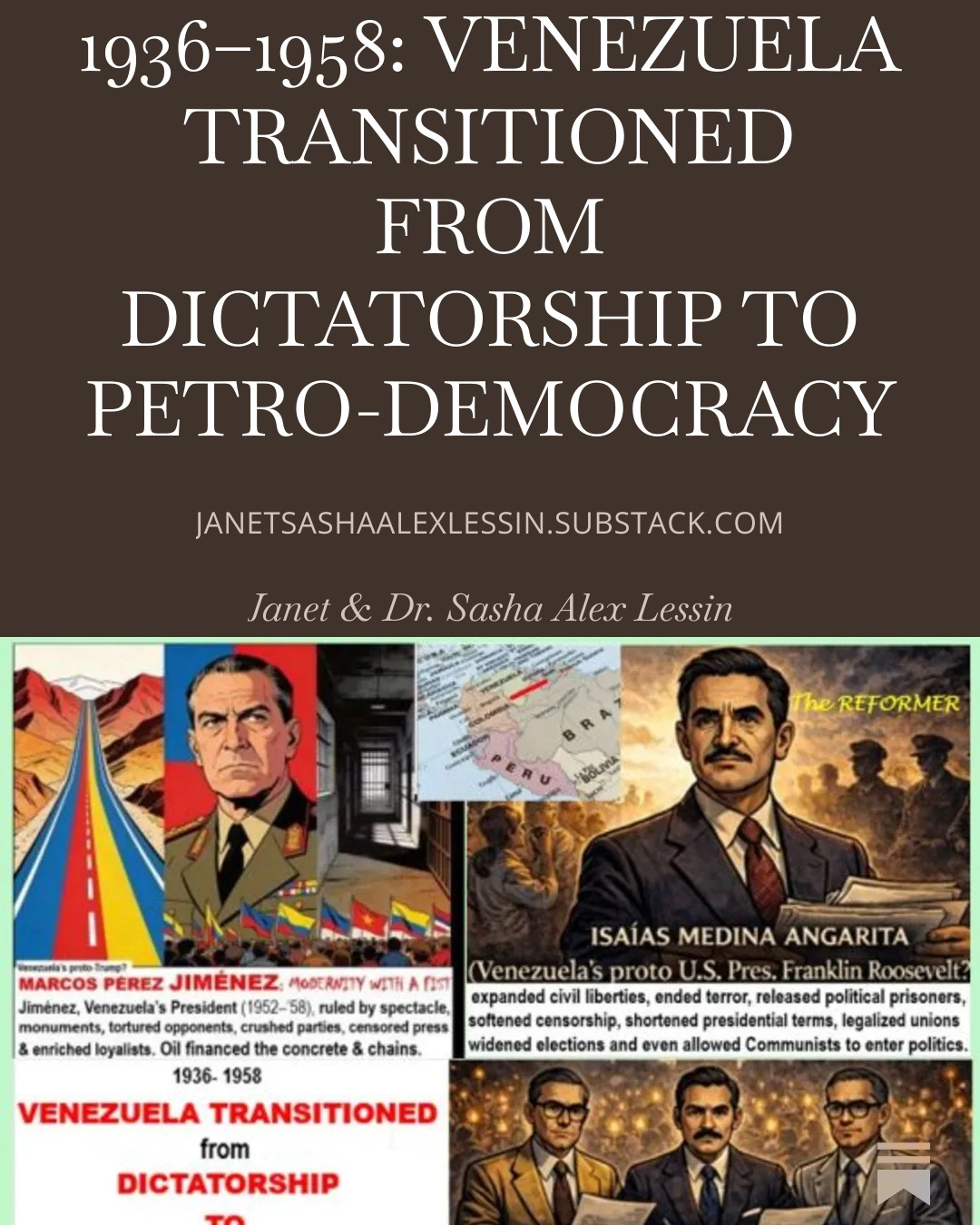
López Contreras inherited a fearful nation and cautiously dismantled terror. He released political prisoners, softened censorship, shortened presidential terms, and introduced modest labor protections. He legalized unions without empowering them. He tolerated opposition without yielding command.
Order breathes, a clerk thinks. Not freedom. Yet.
1941 to 1945: ISAÍAS MEDINA ANGARITA (Venezuela’s President from ): PRESSED REFORM

Medina Angarita expanded civil liberties further. Parties organized openly. Communists entered legal politics. Oil law revisions increased Venezuela’s share of profits. Elections widened but stopped short of universality.
We can see it now, a student whispered. Can we reach it?
The ceiling held. Elites panicked. Reform outran tolerance.
1945–1948: CIVILIAN SURGE, MILITARY RESPONSE
A civilian-military alliance overthrew Medina. Rómulo Betancourt led a transitional government. Universal suffrage arrived. In 1947, Rómulo Gallegos won Venezuela’s first truly democratic election.
In 1948, the military struck back.
1952–1958: MARCOS PÉREZ JIMÉNEZ: MODERNITY WITH A FIST
Marcos Pérez Jiménez ruled through spectacle and fear. He paved highways, raised towers, staged parades, and built monuments. He tortured opponents, crushed parties, censored the press, and enriched loyalists. Oil financed concrete and chains alike.
The buildings shine, a passerby thought, but I hear screams inside.

PRIESTS INTERCEDED QUIETLY BUT EFFECTIVELY
The Catholic Church did not lead a rebellion, but priests sheltered dissidents, transmitted messages, and slowly withdrew moral cover from the regime. The priests decided, God does not bless fear. Letters among them criticized Jiménez’s repression and divided the loyalties of his military.
Venezuelas staged mass protests. Pilots in his airforce defected; army officers refused orders. Jiménez fled on January 23, 1958. The populace celebrated and prayed that fear of a dictator would never again dominate them.
On October 31, 1958, in the town of Puntu, party leaders signed the Punto Fijo Pact, agreeing to respect elections, share power, and exclude military rule. Stability replaced purity. Democracy arrived armored.
Relief floods the streets, a mother thought, We must never again let fascists like Jiménez ever rule us.

WHAT CHANGED—AND WHAT DID NOT
Dictators fell. Oil remained. Power was dispersed among parties rather than among generals. Foreign capital adapted smoothly. Violence paused without disappearing.
We breathe easier now, a worker thought. But we still do not own the valve.
#EleazarLopezContreras #IsaiasMedinaAngarita #MarcosPerezJimenez #Venezuela1958 #PuntoFijoPact #OilState #PetroDemocracy #MilitaryRule #AuthoritarianModernization #ColdWarLatinAmerica #CatholicIntercession #StrongmanPattern
SOURCES & REFERENCES
Brian Loveman, For La Patria
Leslie Bethell (ed.), The Cambridge History of Latin America
Tomás Straka, La Voz de los Vencidos
Venezuelan National Archives (1936–1958)
Zecharia Sitchin, The Lost Realms