

under construction; don’t read this yet
By Sasha Alex Lessin, Ph.D. (Anthropology, UCLA) 700,000–165,000 BCE: EARLY HUMANS IN THE ZAGROS MOUNTAINS Stone tools at Zagros cave sites show very ancient human occupation long before states, priesthoods, or organized warfare. The dominant attitude among such hunter-gatherers was partnership and cooperation; the obsession with imposed domination was largely absent among early bands.  10,000–8,000 BCE: NEOLITHIC TRANSFORMATION Ganj Dareh & Goat Domestication Agriculture and settlement took root. Surplus began to accumulate. Social hierarchy became possible. Ganj Dareh (c. 8000 BCE) is one of the earliest known farming settlements in the Zagros region. Archaeologists found goat bones indicating selective herd management— young males culled, older females kept for breeding. This shows intentional domestication, not merely hunting. Ganj Dareh marks the shift from mobile hunter-gatherers to settled mud-brick villages with managed herds and early food production, an early phase of the wider Southwest Asian agricultural revolution. The cooperative, partnership-dominated behavior of these ancients, whose implicit motto remained “We plant together, we eat together.”
8000–7000 BCE: EARLY AGRICULTURAL VILLAGES IN THE ZAGROS


 4000–3000 BCE: IRAN URBANIZED — ELAM & SUSA By the late 5th and into the 4th millennium BCE, the fertile plains of southwestern Iran saw scattered villages transform into dense urban centers. At Susa, continuous occupation layers dating to around 4200 BCE reveal monumental mud-brick platforms, administrative quarters, and evidence of craft specialization. By c. 3200–2700 BCE, a broader proto-Elamite cultural sphere had formed.
  Administrative devices — clay tokens, numerical tablets, and one of the world’s earliest indigenous writing systems — recorded grain, livestock, labor, and exchange. Writing became an instrument of oversight. Susa stood at a strategic crossroads linking Mesopotamia, the Zagros highlands, and the Iranian plateau. Trade intensified. Authority consolidated. Anunnaki-inculcated Domination Voice of the time mandated: Obey rulers’ decrees, who rule on behalf of our Anunnaki overlords. But the Partnership Paradigm, present as the implied polar-opposite, domination-obsession in the psyches of all Earthlings, whispered to the Persians, as they were now called, “Let the tablet ensure balance. Let the measure be fair.” Writing carried dual potential — control or reciprocity. Here, the plateau crossed a threshold from cooperative village life to stratified urban order. Elam endured for over a millennium, contending with Mesopotamian powers and shaping southwestern Iran long before later empires rose. 1500–1000 BCE: IRON AGE — MEDES Iranian-speaking groups consolidated into early state structures. By the early first millennium BCE, Iranian-speaking pastoral groups had moved across the plateau and into the Zagros Mountains. Out of clan alliances and mountain strongholds emerged the people later called the Medes. What began as tribal coordination hardened into political structure: fortified centers, mounted war bands, and leaders capable of binding scattered highland communities into something resembling a state.
From the 9th to the 7th centuries, Median chieftains emerged as tributaries, then as adversaries. Over time, Median leadership consolidated power across northwestern Iran. Under DEIOCES, justice and centralized authority replaced loose clan rule, and law and hierarchy supplanted diffuse kin leadership. By the late 7th century BCE, the Medes joined forces to attack the Assyrian Empire.

CYAXARES and the Median rulers unified Iranian-speaking tribes of the Zagros highlands into the first large-scale Iranian state structure. By the 7th century BCE, the Medes had forged a confederation capable of confronting — and defeating — the mighty Assyrian war machine. In alliance with Babylon, they helped destroy Nineveh in 612 BCE, ending Neo-Assyrian dominance. Their capital at Ecbatana (modern Hamadan) became a fortified mountain stronghold — strategically positioned between Mesopotamia and the Iranian plateau. The Medes did not create a sprawling bureaucratic empire like the later Achaemenids; rather, they consolidated tribal military strength into coordinated authority.
In 612 BCE, Nineveh fell, and the Median realm stretched across much of western Iran, linking highland routes with Mesopotamian corridors. Though later absorbed by the rising Persians under Cyrus, the Median achievement endures: they demonstrated that Iranian-speaking highland groups could organize durable state power from the mountains outward. The ever-present and dominant Anunnaki precept prompted Mede rulers to unify their subjects with fear; the contraposed Partnership paradigm of ordinary people urged unity, but from trust rather than fear.
550–330 BCE: ACHAEMENID EMPIRE  Founded by CYRUS The Great and expanded under DARIUS I, the Achaemenid Empire became the first true transcontinental power, stretching from the Indus Valley to the Aegean and from Egypt to Central Asia. What distinguished it was not merely conquest, but organization. Darius divided the vast territory into satrapies—administrative provinces governed by appointed officials—while instituting standardized taxation, imperial road systems, and regulated tribute. Local customs, languages, and religions were often permitted to continue, provided loyalty and revenue flowed toward the imperial center. Thus, taxation and tolerance coexisted in a calculated balance: autonomy beneath overarching authority.


Cyrus of Persia conquered Babylon in 539 BCE. 


Marduk, Babylon’s resident Anunnaki “god,” [or maybe it was just his statue, whose hands he grasped] welcomed Cyrus. Cyrus returned the Israelite hostages of Nebuchadnezzar to Jerusalem. Cyrus’ successor, Cambyses, conquered Sumer, Mari, Mitanni, Hatti, Elam, Assyria, Egypt, and the Persian Empire.  King Cambyses of Persia conquered Sumer
In 522 BCE Darius murdered Cambyses and ruled the extended Persian Empire.  Darius


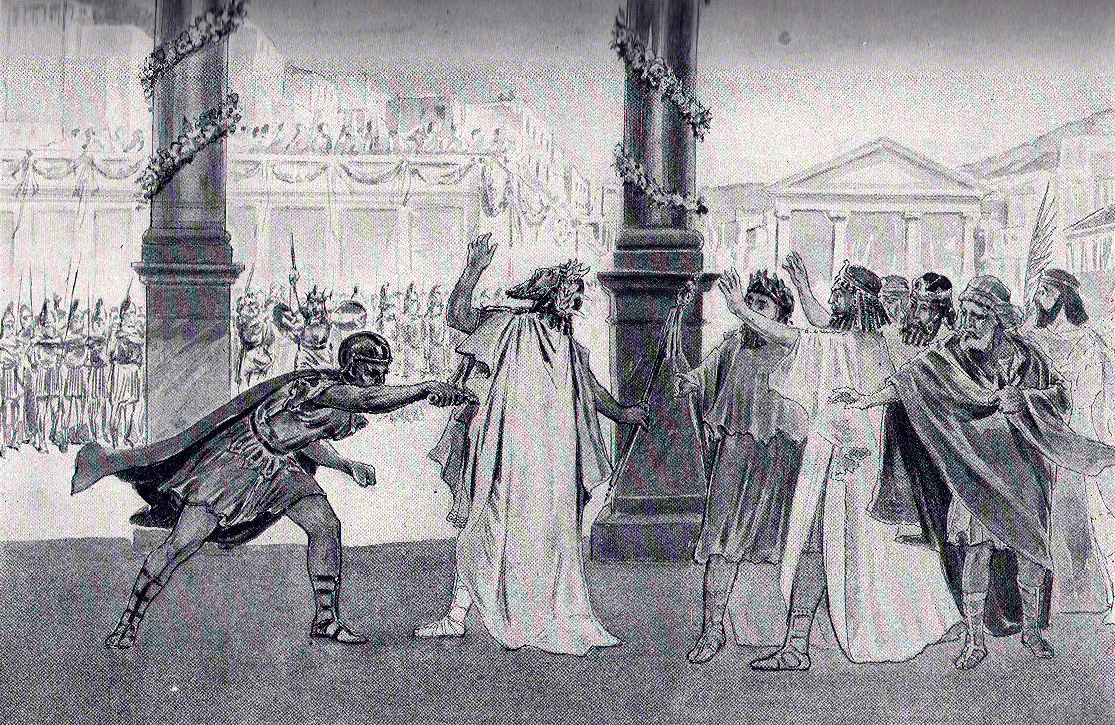


247 BCE – 224 CE: PARTHIAN & SASANIAN RESURGENCE
(Parthians) Mobile cavalry state resists Roman expansion. coming attractions; stay tuned
637–642 CE: ISLAMIC TRANSFORMATION. The Arab conquest ended the Sasanian state. Graphic Concept: Aftermath of al-Qadisiyyah, banners lowered. Domination Voice: “New banner, same command.” Partnership Voice: “Belief should uplift, not conquer.”
1501 CE SAFAVID ERA 1501 CE — Shah Ismail I Shi’a Islam institutionalized as state identity. Graphic Concept: Shah Ismail in Qizilbash headgear. Domination Voice: “Uniform belief ensures obedience.” Partnership Voice: “Unity does not require coercion.”
MODERN STATE FORMATION 1905–1911 Constitutional Revolution. First parliamentary experiment challenges monarchy. Domination Voice: “Parliaments weaken kings.” Partnership Voice: “Power shared is power stabilized.”
1951–1953 — Mohammad Mosaddegh’s oil nationalization. 1953 coup alters trajectory. Domination Voice: “Control the oil. Control the future.” Partnership Voice: “Resources belong to the people.”
1905–1911: PAHLAVI ERA — Mohammad Reza Pahlavi promoted modernization and repression expanded simultaneously. Domination Voice: “Progress requires obedience.” Partnership Voice: “Progress requires participation.”
1980–1988: ISLAMIC REPUBLIC 1979 — A clerical state that Ayatollah Khomeini led replaced the Pahlavi Monarchy. Iran–IrRuhollah Khomeiniaq War Domination Voice: “War strengthens authority.” Ayatollah Ruhollah Khomeini, the founder and first Supreme Leader of Iran, served as the country’s top authority from 3 December 1979 until his death on 3 June 1989. He was succeeded as Supreme Leader by Ayatollah Ali Khamenei, who assumed the position on 4 June 1989 following Khomeini’s death. On June 4, 1989, the U.S. applied sanctions to Iran over its efforts to develop nuclear bomb and missile capacity.
1989–February 28, 2026 U.S./ISRAEL AIRSTRIKE KILLED KAHMENEI; IRAN PRESIDENT RULES
American President Donald Trump announced that Supreme Leader Ayatollah Ali Khamenei was killed in joint strikes on Iran. Masoud Pezeshkian remains the president of Iran. He is one of three members of the country’s leadership council, an interim body constitutionally tasked with carrying out the supreme leader’s duties after Ali Khamenei’s death left the post vacant until a conclave of religious leaders selects a new Ayatollah. Pezeshkian favors a nuclear agreement with the West and modest social and political reforms at home. He is the most reform-oriented president since Mohammad Khatami (1997–2005), under whom he served as minister of health (2001–05), although he is considered a regime loyalist and is restrained by a historically conservative Majles (parliament). As a member of the Majles (2008–24), he criticized the government for the death of Jina Mahsa Amini, the strict imposition of hijab, and law enforcement’s brutal reaction to popular protests beginning in 2009. As president, he backed the government in its crackdown on the 2026 protests, which he accused of being fomented by foreign actors amid threats by the United States and Israel to intervene.
#IranTimeline #PersianEmpire #Zagros #Elam #Susa #Achaemenids #Darius #AlexanderTheGreat #Parthians #Sasanians #Safavids #Mosaddegh #Pahlavi #IslamicRevolution #MiddleEastHistory #AncientToModern #Geopolitics #SashaAlexLessinPhD


