The Irish Took the Blow and Carried the Fire
The Irish rose from a land that England treated as expendable—a field to harvest, a people to grind down, a spirit to break. From the Boyne to the Penal Codes, from Cromwell’s burnings to the Great Hunger, each generation carried scars that were meant to silence them. Instead, those scars hardened into resolve. When the blight blackened their fields in the 1840s, and the empire shipped food out of starving Ireland, the Irish understood that their choice was brutal but clear: die at home or gamble everything on the ocean.
So they boarded coffin ships—mothers, fathers, rebels, widows, dispossessed farmhands, children with ribs showing—and crossed into the roar of the Atlantic. Half-dead, half-hopeful, they stepped onto American docks and discovered that the promise whispered across the sea came with a price: they were expected to dig the canals, fight in the Union ranks, police the cities, build the railroads, and absorb the blows of a nation still deciding who counted as fully human.
But the Irish had endured centuries of domination. They recognized the machinery instantly: landlords, bosses, capital, empire—different masks, same power. And so, in America, they did not simply survive. They organized. They resisted. They shaped unions, political machines, draft riots, and new identities. Their story is not just a migration. It’s a continuum of class struggle that threads Ireland’s broken fields to America’s factories, copper mines, battle lines, and tenements.
This series follows that fire.
THE GREAT LEAVING: 1845–1855
The potato fields blackened. Blight spread across Ireland like a creeping shadow, and families watched their harvest rot in their hands. Food existed—grain, cattle, butter—but was exported under English landlords’ protection. Irish peasants starved beside full storehouses.
Parents whispered to their children, “We cannot stay.”
Old ones murmured, “The coffin ships will devour us.”
Still, they walked toward the ports.
Between 1845 and 1855, over 1.5 million Irish boarded ships for America. Many died en route. Those who survived arrived skeletal, desperate, carrying nothing but the will to live.

FIRST STEPS ON AMERICAN STREETS
The Irish disembarked in cities that shuddered under industrial smoke—New York, Boston, Philadelphia. Streets swarmed with wagons, horses, newsboys, factory whistles. Irish newcomers stumbled from the docks into the lowest rung of America’s class hierarchy.
Signs in shop windows read: NO IRISH NEED APPLY.
A foreman squinted at a young man from Cork, then growled, “You’ll take the job no one else wants—and less pay.”
Irish women scrubbed floors and carried wash. Men dug canals, laid track, and dreamt of someday eating until full.
THE BOTTOM RUNG: CLASS AMERICA RECEIVES A NEW WAVE
American society sorted them instantly.
Talcott Parsons once said modern societies shift from ascribed status (birth, lineage) to achieved status (effort, skill). Yet Irish immigrants discovered the opposite: they were ascribed poverty before they could achieve anything at all.
Zinn’s view matches their reality: America was built not by elites but by the oppressed, the hungry, the laborers who had no choice but to sell their bodies cheaply to survive.¹
Reich adds that inequality—then and now—locks newcomers into the lowest strata while wealth concentrates above.²
Hartmann notes the recurring pattern: elites redefine dominance, and newcomers must fight through structures designed to keep them in place.³
The Irish lived this contradiction. They arrived with nothing. They absorbed blows meant for the poor. And yet—they climbed.
LABOR, BLOOD & ORGANIZING: THE MAKING OF IRISH AMERICA
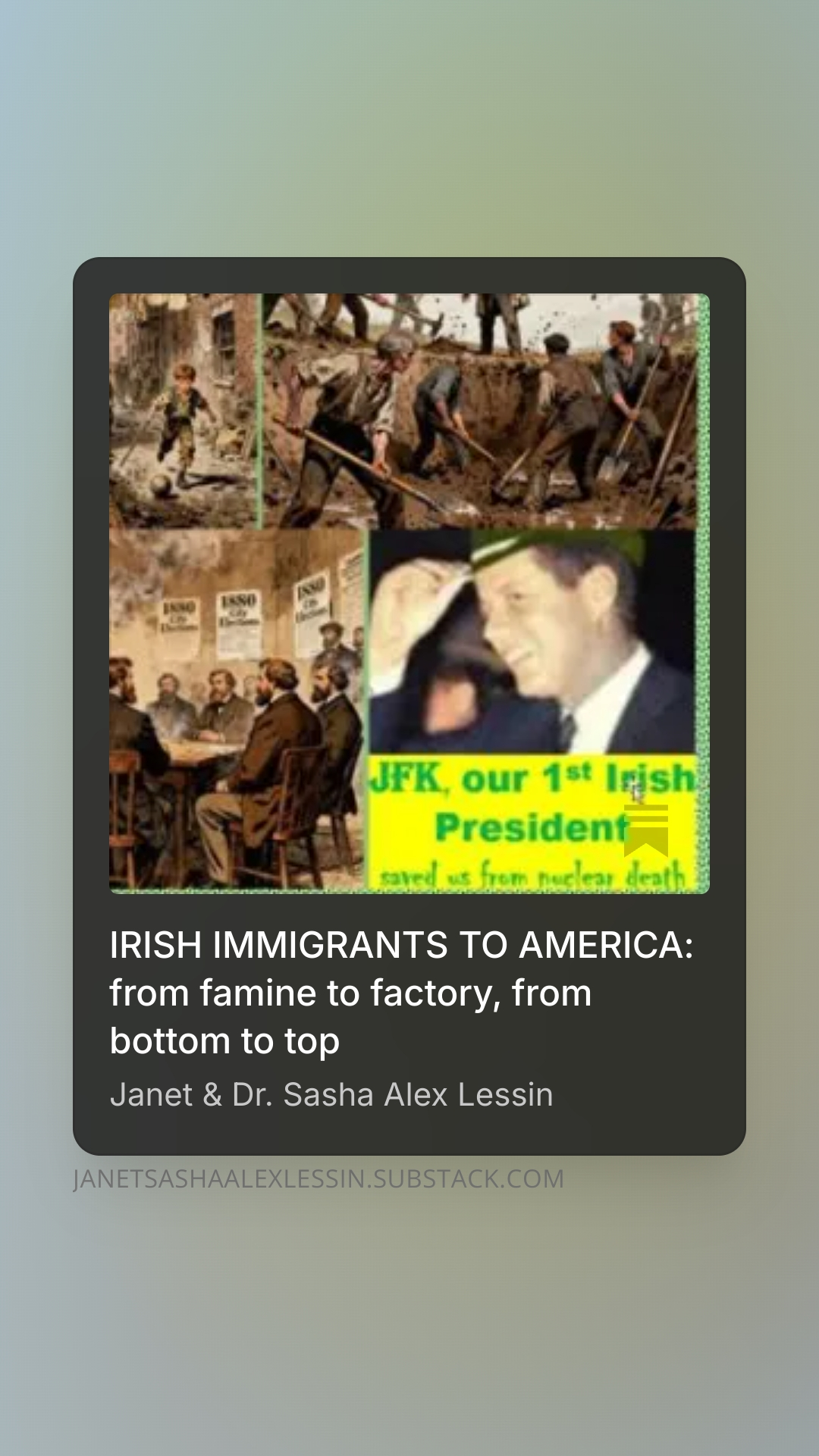
Irish workers laid railway ties through forests and mountains. They dug the Erie Canal, dying in its trenches. They joined city labor gangs—then unions—fighting for higher wages and safer conditions.

In the factories, foremen barked orders, but one woman snapped back in her native Gaelic, “We made it through famine; we will not bow now.”
Irish solidarity grew through parishes, wards, and longshoremen’s meetings.
They built enclaves—South Boston, Hell’s Kitchen, Five Points—poor but united.

From these neighborhoods rose the political machines. Tammany Hall reached into the tenements with jobs, relief, and the promise of influence. Irish immigrants gained power first through numbers, then through organization.
ASCENT THROUGH INSTITUTIONS: POLICE, FIRE, POLITICS
The Irish entered police forces because the jobs were steady and available. They entered firefighting because few others dared. They entered city politics because their communities needed champions.
In smoky backrooms, men in wool coats said, “We vote together. We rise together.”

Their sons became ward bosses and aldermen.
Their daughters became teachers and nurses.
Within two generations, the Irish went from starving newcomers to the beating heart of American cities.
This is where Parsons finally becomes relevant: the Irish achieved status—yet quickly re-ascribed it to their children. Success hardened into privilege. Dominance patterns repeated.
And the next immigrant wave—Italians, Jews, Slavs—took the bottom rung.
WHEN THE OPPRESSED BECAME THE GATEKEEPERS
Irish immigrants defended their new positions fiercely.
They fought incoming groups for jobs, wages, housing.
They dominated New York City’s Fire and Police Departments. Irish cops beat back strikes of later immigrants. The curse of domination consciousness and class system programming turns its aggression against the next group of immigrants.

Irish unions sometimes excluded newcomers.
A young laborer from Sicily once muttered on a loading dock, “They were treated like dirt—now they treat us like it.”
The cycle of ethnic succession continued: one wave suffers → rises → protects gains → suppresses the next.
The Irish did not invent this pattern—but they became central players in it.
PARTNERSHIP AND DOMINATION IN THE NEW WORLD
The Irish brought rich communal traditions, storytelling, hospitality, spiritual resilience, and partnership traits. But starvation, colonial oppression, and class war forged them into instruments of domination once power arrived. The Irish immigrant experience shows the truth Harman, Zinn, Reich, and Eisler all circle: Trauma creates domination unless healed; suffering does not guarantee compassion.
THE LEGACY OF THE IRISH IN AMERICA
By 1900, Irish Americans were firefighters, police captains, teachers, mayors, senators, and business owners. They shaped labor unions, political machines, and city cultures. Their upward climb helped build the American middle class—yet it also helped build America’s ironclad class barriers.
Still, one can imagine an elder Irish grandmother rocking on a stoop, whispering to a child, “We came with nothing. Now look at us. Remember where we started. Remember who comes after.”

RECOMMENDED READING
- Howard Zinn, A People’s History of the United States — chapters on labor, immigrants, class struggle.
- Robert Reich, Inequality for All (film) & congressional testimony on income inequality.
- Thom Hartmann, The Hidden History of American Oligarchy — cycles of elite dominance.
- Noel Ignatiev, How the Irish Became White — a crucial text on Irish class ascent and racial positioning.
- Kerby Miller, Emigrants and Exiles: Ireland and the Irish Exodus to North America.
- J.J. Lee, Ireland, 1912–1985: Politics and Society (for background).
FOOTNOTES
¹ Zinn, Howard. A People’s History of the United States (Harper, 1980).
² Reich, Robert. “Income Inequality in the United States” (Testimony to Joint Economic Committee, 2014).
³ Hartmann, Thom. The Hidden History of American Oligarchy (Berrett-Koehler, 2021).
#IrishImmigration #GreatHunger #IrishAmericans #ClassStructure #EthnicSuccession #LaborHistory #Zinn #Reich #Hartmann #TalcottParsons #PartnershipVsDomination #TammanyHall #ImmigrantLabor #AmericanInequality #IrishWorkingClass