VENEZUELA: WAR IS AGAIN A CAREER PATH & MAKE-BELIEVE THREATS AGAIN CURTAIL CIVILIAN OVERSIGHT
By Janet Kira Lessin, CEO, World Peace Association
Wars do not merely destroy nations; they construct ladders. Someone always climbs while others fall, and the higher the bodies pile, the steeper the ascent becomes for those who learn how to frame conflict as necessity rather than choice. By the time the public notices the cost, the beneficiaries are already installed, insulated by power, medals, and the language of “security.” Vietnam was the last time this pattern fractured under the weight of public disgust.
That rupture did not end the war; it taught its architects a lesson they would never forget. Never again would images, numbers, and raw human grief be allowed to interrupt momentum. Never again would narrative control be surrendered to witnesses, reporters, or moral shock. What followed was not restraint, but refinement.

WARS ARE DICTATORS’ BIDS FOR MORE POWER
Trump’s attack on Venezuela avoided a formal declaration of war. Still, it cited the oil infrastructure of American companies that Venezuela’s President Chavez nationalized and, like Cheney’s takeover in Iraq, entitled America to oil from Venezuela.

Where Vietnam relied on claims of attacks in distant waters, the Venezuelans’ conflicts relied on boats again—intercepted, targeted, or erased from the story before questions can form. The language shifted from “communism, the fear-mongered threat LBJ used to intervene in Nam, to “drugs,” which Trump used as his excuse to invade Venezuela. The U.S. President thus shifted from Johnson’s ideological excuse to the excuses of drug-trafficking criminality.
Still, the function of both excuses for foreign intervention remained identical: remove political complexity for commoners, replace it with a threat like drug-trafficking or re-assertion of the Monroe Doctrine, that the U.S. must run the Western Hemisphere lest the Chinese will. Enemies are no longer soldiers; they are smugglers, traffickers, terrorists, or “bad actors.” Once labeled, they need not be captured, questioned, or tried.
They can disappear. There are no prisoners to interview, no draft notices arriving at suburban homes, no hometown newspapers printing faces of the dead. The war no longer enters the living room. It hums quietly in the background while daily life continues uninterrupted. This is not an accident of technology; it is a political achievement.
WARS CREATE LEADERS

Wars now function as proving grounds for ambition. They generate credentials, command experience, security portfolios, and media visibility. Those who rise do so not despite the chaos, but because of it. Civilians are reduced to abstraction, invoked rhetorically but never centered. Suffering becomes a statistic at best, a rumor at worst. In Vietnam, leaders still feared the camera. They feared the photograph that could undo a speech, the headline that could shatter a justification, the body count that could not be spun fast enough.
Today, fear has shifted downward. Civilians fear invisibility more than death, because invisibility guarantees that nothing will change.
THE ANUNNAKI OVERLAY: DOMINATION VS. PARTNERSHIP
Backstory: Large White Homo sapiens from the Planet Nibiru had built stations along the Tigris and Euphrates Rivers from which to process gold they mined in southeast Africa, then rocketed it back to their home planet to refine it into powder for an atmospheric shield for their planet and as a life-extending medicine for themselves. The culture of the Nibirans was that of unrelenting, lethal individual and factional competition within military hierarchies of dominance.
They mixed their genes with those of Homo erectus humans who lived in Africa to create slaves. The first breeders they made, 300,000 years ago, of these Hybrids (our ancestors) were a brown male (Adamu) and a white, blue-eyed female (Ti-amat). 200 000 years ago, their Chief Scientist bred an enhanced Ancestor, Adapa, whose Kings became the visible rulers of the rest of our ancestors. After Noah’s flood of 13,000 years ago, the Anunnaki organized us into comfortable, multistoried city-states, each built around their castles, which they called temples.
They maintained a strict hierarchical caste and class system, much like those of most of Earth’s present-day nation-states. They indoctrinated their hyper-competitive, murderous, and misogynistic attitudes on our Earthling ancestors and the Hybrids they beget to run us. Anunnaki big shots deliberately fostered rivalry among their fiefs, so we Hybrids would never, they hoped, organize against them. Anunnaki Princess Ninmah, the Peacemaker (aka the Great Goddess), enlisted Enki in a program to balance Earthlings’ addiction to lethal conflicts with programs of cooperation, minimal-needs guarantees, and an ecological embrace of Earth’s nature.

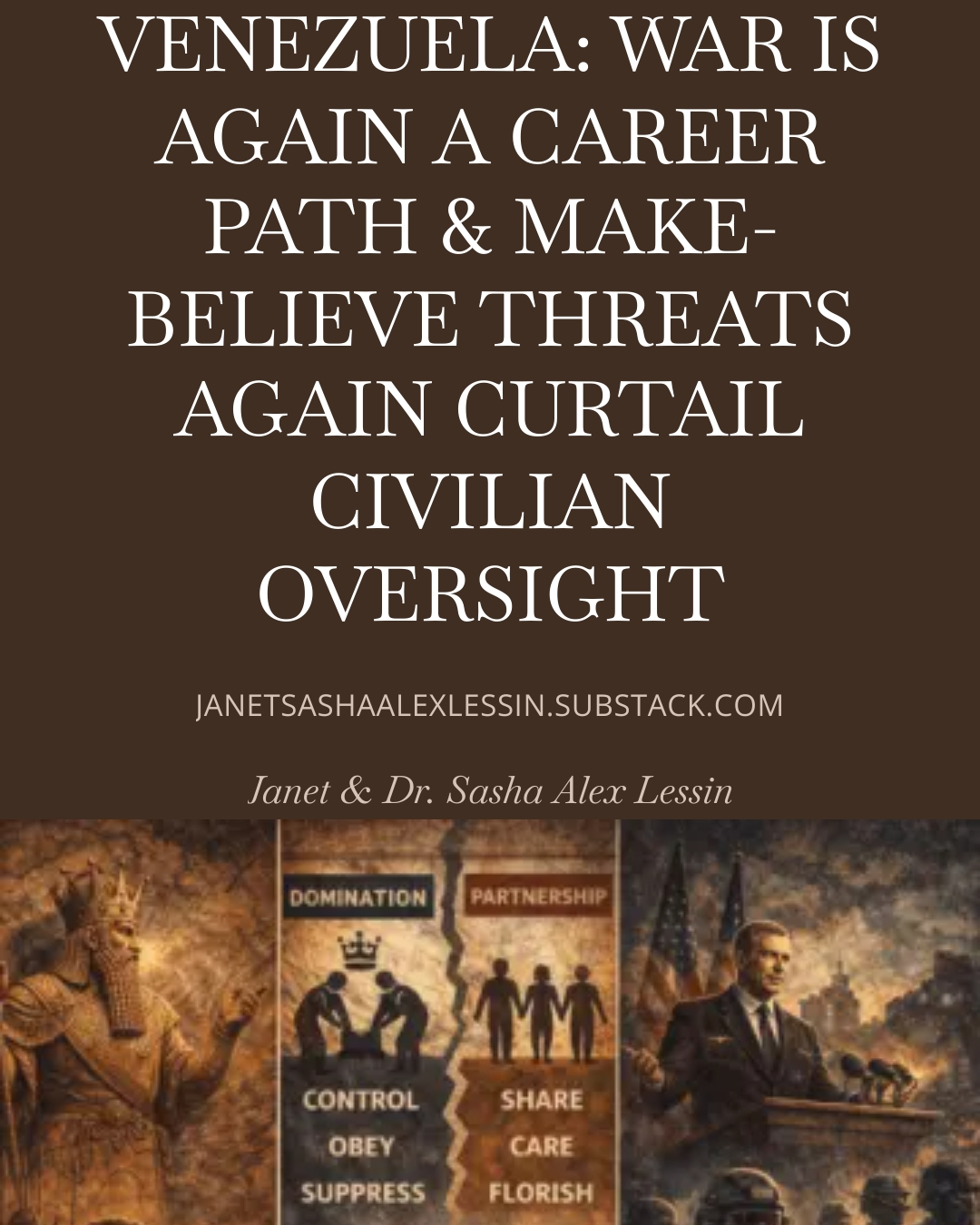
Through the Anunnaki overlay, this pattern reads as ancient. Domination consciousness—associated with control hierarchies often symbolized by Enlil–Marduk archetypes—demands obedience, sacrifice, and silence. War divides populations, exhausts resistance, and redirects creativity toward destruction. Partnership consciousness, by contrast, prioritizes care, accountability, and shared prosperity—qualities systematically displaced when war becomes policy.

THE PSYCHOLOGICAL PAYOFF—AND THE BILL
Many who support these operations do not do so out of cruelty, but out of psychological need. War offers belonging, clarity, and purpose. It simplifies a chaotic world into teams, uniforms, and enemies. It promises meaning to those who feel dislocated, valor to those who feel ignored, and righteousness to those who fear irrelevance. But the system does not reward loyalty; it consumes it. Those who die believing they served a noble cause often meet, in conscience if not theology, an unbearable clarity: their courage was real; its use was not.

WHEN SHOCK FAILS
Venezuela reveals what Vietnam taught: wars persist not because everyone believes the lie, but because enough people are exhausted, distracted, or anesthetized to stop resisting it. There is no single image left to break the spell. No magazine cover. No nightly body count. The absence is engineered. When war no longer shocks, it no longer needs to justify itself. It becomes procedural, bureaucratic, and normalized. It becomes policy. It becomes a career.

References
- Zinn, Howard. War Is a Force That Gives Us Meaning.
- Harman, Chris. A People’s History of the World.
- Hartmann, Thom. The Hidden History of American Oligarchy
#VietnamWar, #Venezuela, ManufacturedWar, #Propaganda, #Trump, #NarrativeControl, #Dictators #DominationConsciousness, #PartnershipConsciousness, #Ninmah #Enki, #Enli, #AmericanNavy #AnunnakiOverlay, #Careerism, ImperialHistory, #PeaceStudies, #MediaCritique, #Anthropology #JanetLessin #Nam Please share this post; give peace and democracy a chance.
SUBSCRIBE
Follow this series on Substack for updates, revisions, and companion essays. https://substack.com/@janetalexlessinphd